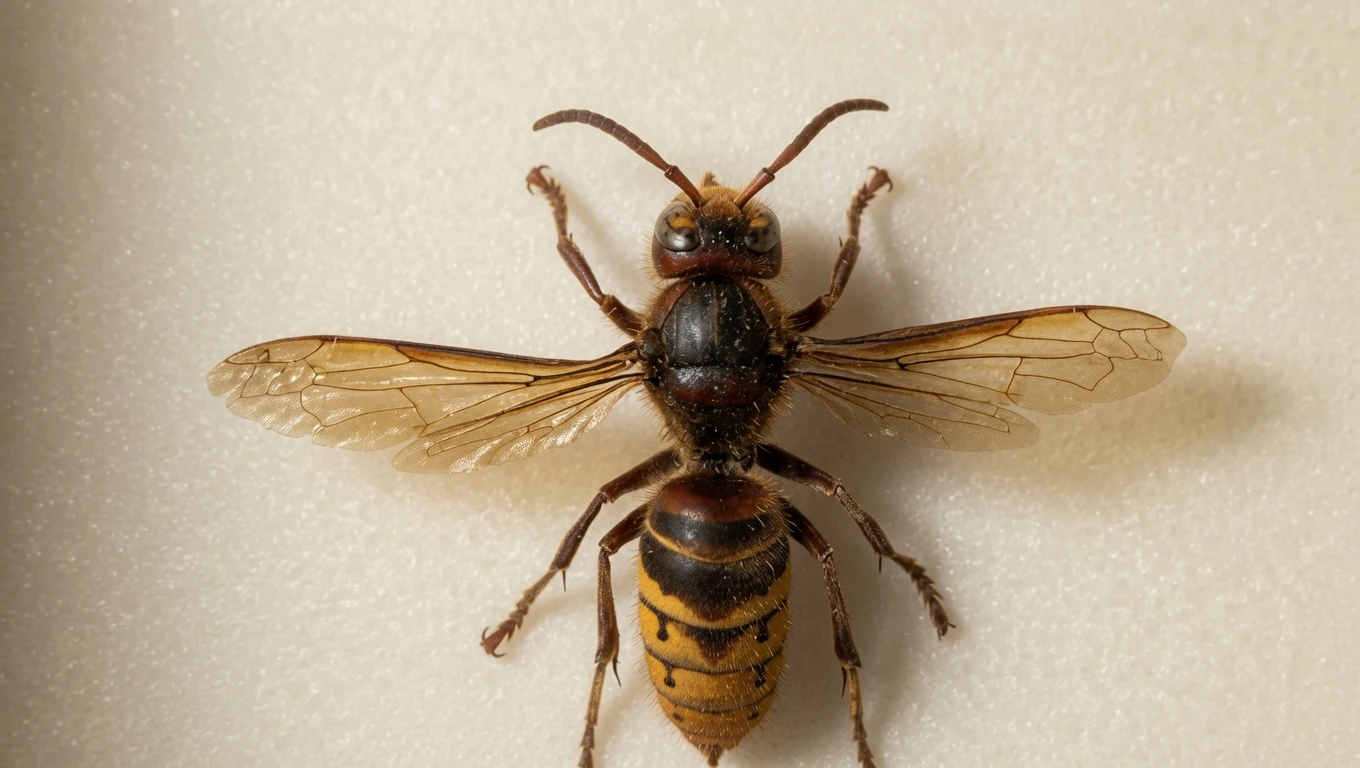
European hornet
Vespa crabro
Description
The European hornet (Vespa crabro) is Europe's largest social wasp: the queen can exceed 3 cm. It is reddish-brown and yellow and builds nests in tree cavities, lofts and crevices. It is a native species and a useful predator of other insects.
Despite its imposing appearance, it is generally less aggressive than the common wasp, but its sting is powerful. It should be distinguished from the Asian hornet (Vespa velutina), an invasive species with a black thorax and yellow leg tips. If unsure, keep your distance and request an assessment.
Key characteristics
Queen up to ~35 mm; workers and males 20–25 mm
Reddish-brown and yellow
Native and beneficial species
Tree cavities, lofts, crevices
Generally not very aggressive; powerful sting
Risks and spread
The European hornet benefits the ecosystem; the risks concern stings and nests near frequently used areas.
- Sting — Powerful and painful; dangerous for people with allergies.
- Nearby nests — Nests in lofts or crevices near homes can pose a risk.
- Confusion with Vespa velutina — Must be distinguished from the invasive Asian hornet (Vespa velutina), which should be reported.
Prevention
-
1
Seal cavities and access to lofts and crevices
-
2
Do not disturb nests and keep your distance
-
3
Report nests in risky locations for assessment
-
4
If unsure of the species, keep your distance and request an inspection
Our intervention
TIsistemo assesses the situation and safely removes nests in risky locations. Suspected Asian hornets (Vespa velutina) should be reported promptly through the national platform calabroneasiatico.ch; in Ticino, control is coordinated at cantonal level.
-
Identification Identifying the species and assessing the risk.
-
Safe removal Treating the nest with protective equipment, only when necessary.
-
Securing the site Closing cavities and entry points to prevent new nesting.
-
Monitoring Checking that no new activity is present.
Same category
Other pests we handle
Got a problem? Call us now.
Rapid response across Canton Ticino and Italian-speaking Graubünden. Free quote.