Housefly
Musca domestica
Description
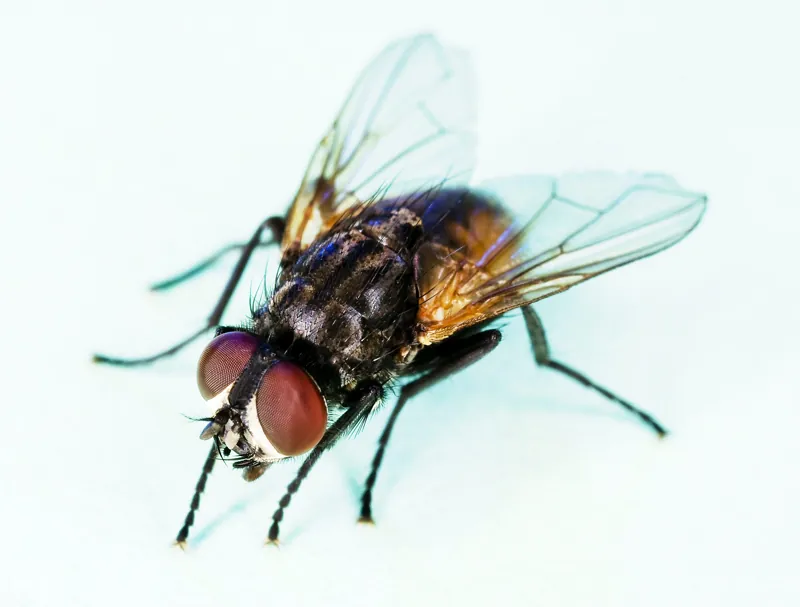
The housefly (Musca domestica) is 6–7 mm long, grey with four dark stripes on its thorax. It develops very rapidly in organic waste, droppings and decomposing matter.
It moves freely between outdoor and indoor environments, landing on food and surfaces. It is a typical mechanical vector: its legs and mouthparts carry microorganisms that can contaminate food.
Key characteristics
6–7 mm
Grey, 4 dark stripes on thorax
Rapid in waste and organic matter
Lands on food and surfaces
Mechanical vector of microorganisms
Risks and spread
The housefly is primarily a hygiene risk: it can contaminate food and surfaces by carrying germs.
- Contamination — Carries microorganisms onto food and surfaces, posing a hygiene and health risk.
- Food businesses — A significant problem for catering, food businesses and livestock farming.
- Proliferation — Rapid life cycles: a few organic sources can produce large numbers.
Prevention
-
1
Manage waste, food waste and organic matter properly
-
2
Keep kitchens, rooms and outdoor areas clean
-
3
Install insect screens and protect food
-
4
Eliminate larval breeding sites
Our intervention
TIsistemo addresses breeding sources and, where needed, uses traps and targeted treatments.
-
Site inspection Locating larval breeding sites and attractants.
-
Source removal Hygiene measures and management of organic materials.
-
Targeted treatment Traps, UV lamps and specific products where necessary.
-
Monitoring Checks to keep the population low.
Same category
Other pests we handle
Got a problem? Call us now.
Rapid response across Canton Ticino and Italian-speaking Graubünden. Free quote.