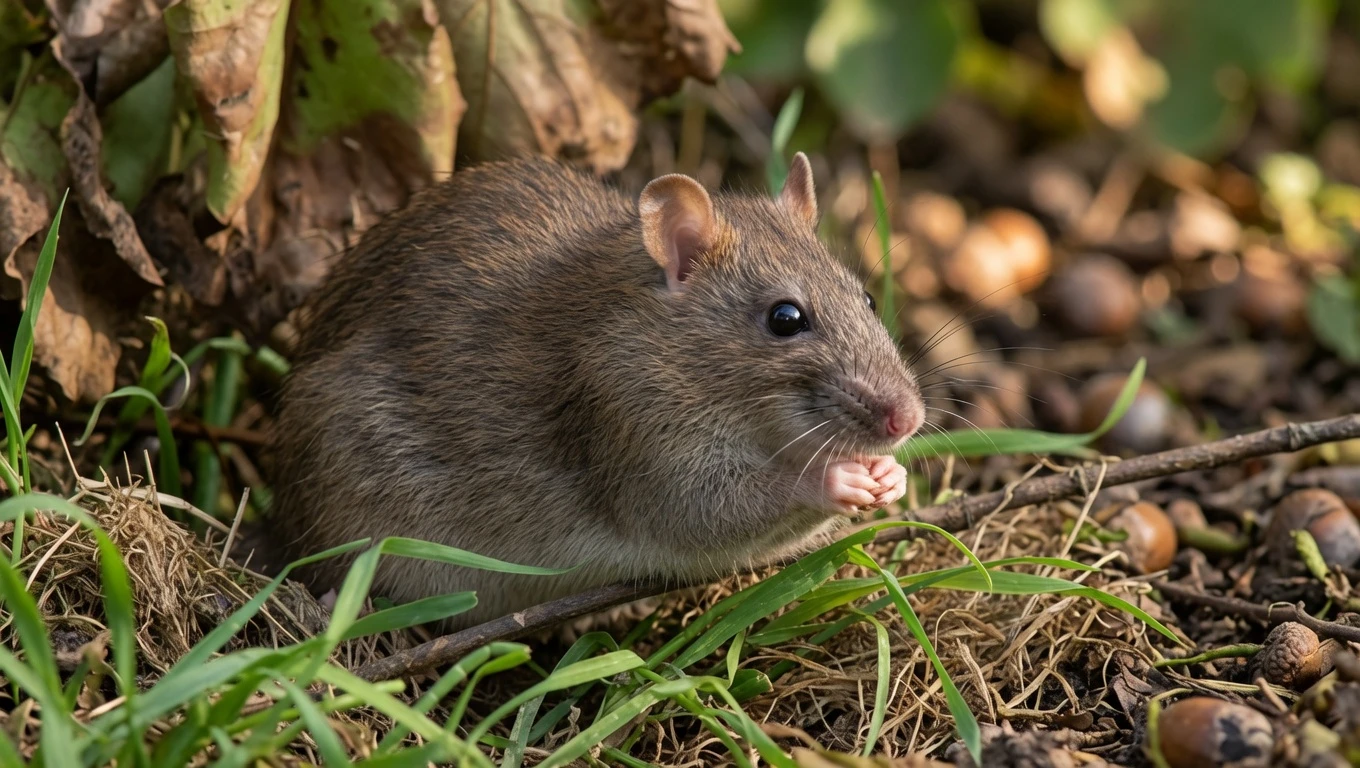
Brown rat
Rattus norvegicus
Description
The brown rat (Rattus norvegicus), also known as the Norway rat or sewer rat, is the largest commensal rodent in our surroundings. Its body can reach 25 cm, plus a hairless tail shorter than its head and body combined (unlike the black rat, whose tail is longer than its body); it generally weighs 400–600 g. Its fur is coarse, grey-brown on the back and lighter on the belly, with a blunt snout and small ears.
It lives in hierarchical colonies and digs elaborate burrows near sewers, cellars, warehouses and areas with food and water. An opportunistic omnivore, it adapts to a wide variety of foods, from urban waste to stored supplies.
Reproduction is continuous under favourable conditions: gestation lasts around 21 days, with numerous young per litter and several litters per year. This prolific breeding makes prompt intervention essential.
Key characteristics
Body up to 25 cm; hairless tail shorter than the body
400–600 g (up to 900 g)
Coarse, grey-brown; lighter belly
Hairless, pinkish or brownish
Colonial and hierarchical; digs burrows
Several litters a year, with numerous young
Risks and spread
The brown rat is among the most feared pests because of its hygiene and health impact, structural damage and rapid breeding.
- Public health — It can carry various zoonoses (such as leptospirosis, for which rodents are a reservoir and which is notifiable in Switzerland, and salmonellosis) through droppings, urine and parasites.
- Food contamination — It soils food and surfaces with droppings, urine and hair, rendering stocks and supplies unusable.
- Structural damage — It gnaws cables, pipes and insulation; its tunnels can undermine paving and foundations.
- Proliferation — Continuous, prolific breeding: the infestation grows quickly if left unmanaged.
Prevention
-
1
Remove access to food and water (closed containers, proper waste management)
-
2
Seal openings, drains and gaps that rodents can pass through
-
3
Keep cellars, warehouses and outdoor areas clean and tidy
-
4
Keep building perimeters clear of piled materials
-
5
Periodically inspect sewers, building cavities and utility rooms
Our intervention
TIsistemo implements an integrated rodent control plan tailored to the environment and extent of the infestation, with due regard for safety.
-
Site inspection Identification of burrows, routes, signs of activity and food sources to determine the scope of treatment.
-
Securing the site Exclusion measures and environmental sanitation to remove access, shelter and food.
-
Control Trapping and baiting in secure stations along routes and at critical points, out of reach of people and non-target animals.
-
Monitoring Scheduled checks to confirm elimination and prevent reinfestation.
Same category
Other pests we handle
Got a problem? Call us now.
Rapid response across Canton Ticino and Italian-speaking Graubünden. Free quote.